

Art can serve as a bridge between generations. It can carry memories from the past, provide a language for the present, and create possibilities for the future. Traditional techniques can be reinterpreted by contemporary artists, while children can discover new forms of expression through experiences rooted in their surroundings.
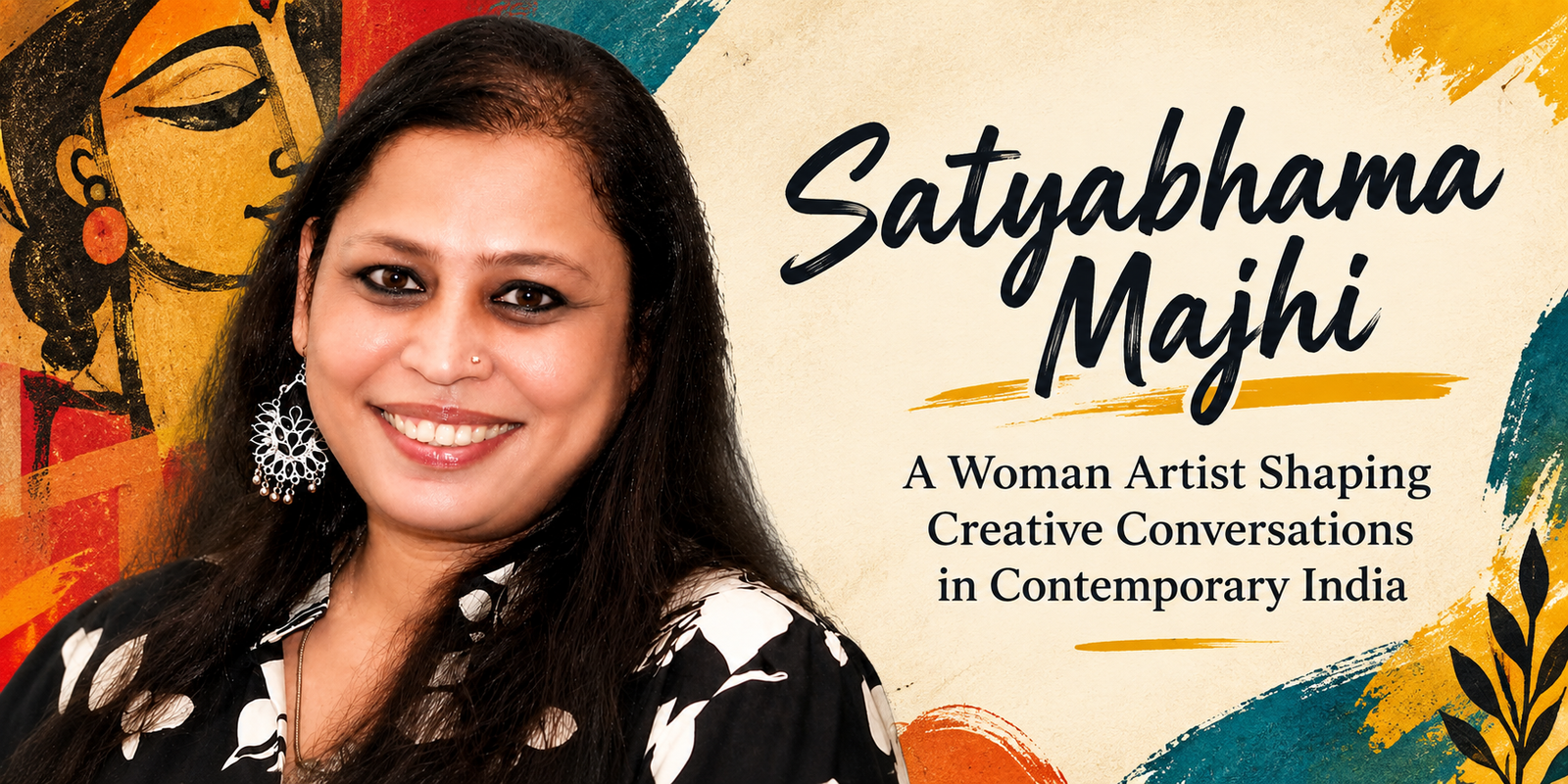
For Indian contemporary artist Satyabhama Majhi, this movement of knowledge and creativity between generations is an important dimension of her artistic journey.
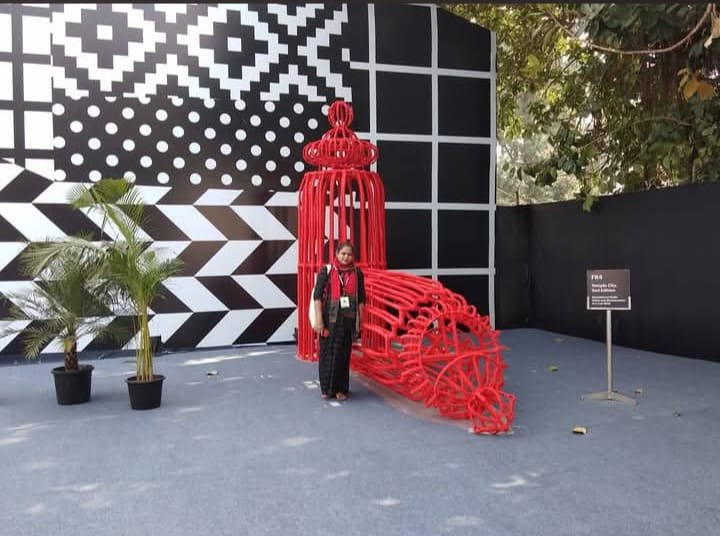
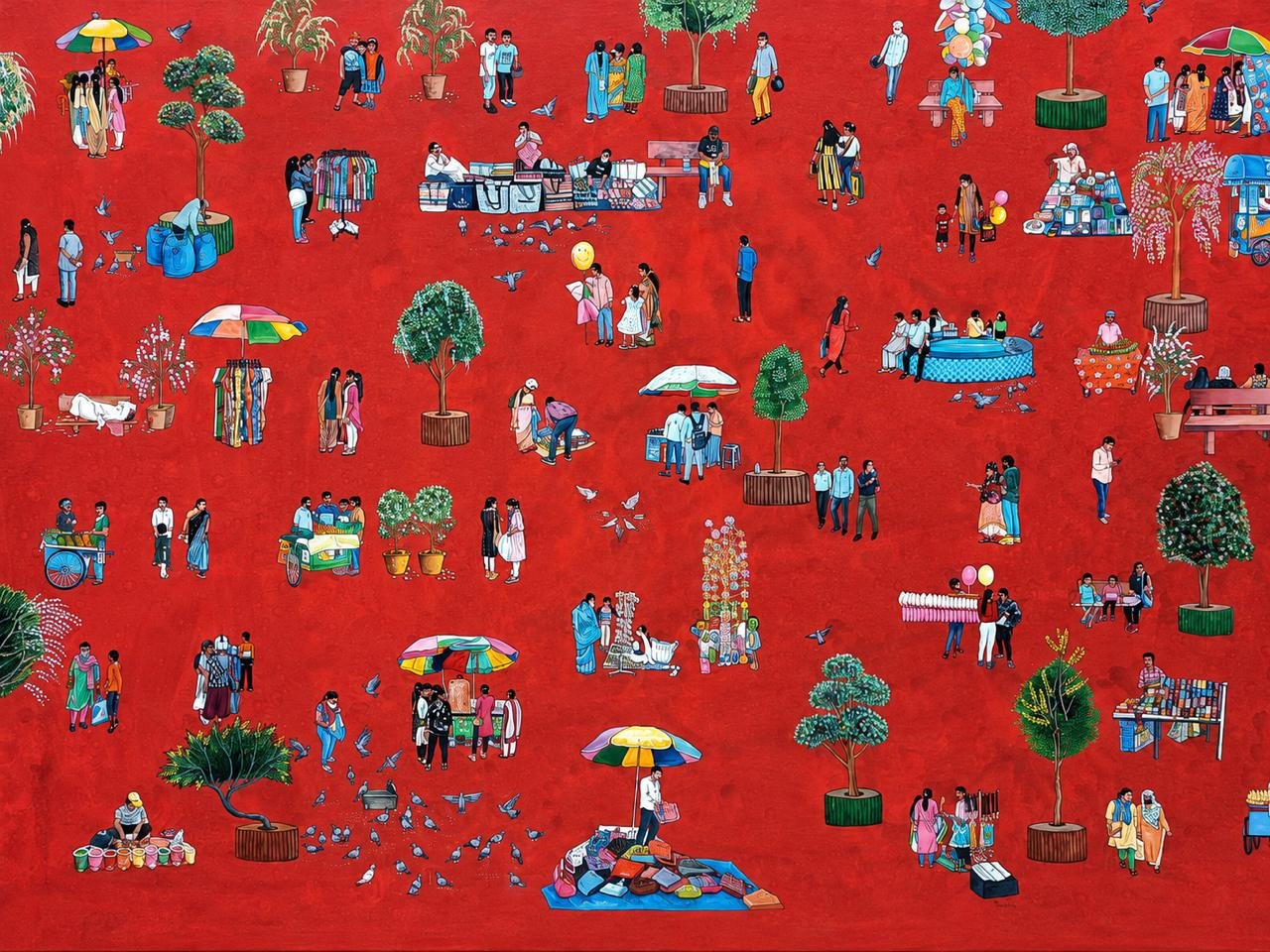
Based in Bhubaneswar, Odisha, Majhi has worked across painting, sculpture, installation, photography, mixed media, public art, education, community practice, and cultural initiatives. Her work brings together seemingly different environments—traditional art practices, indigenous communities, urban neighbourhoods, schools, public spaces, and contemporary art platforms.
At the centre of this diverse practice is a continuing interest in how experiences and knowledge can move from one generation to another.
Art as a Bridge Between Past and Present
Tradition is often described as something inherited from the past.
But traditions survive only when they remain connected with living communities.
Art can help create that connection.
Traditional techniques, motifs, materials, stories, and visual systems can be carried into contemporary contexts without simply being copied.
Majhi’s background in traditional art education provides an important foundation for this approach.
Her contemporary practice demonstrates how knowledge acquired through traditional art can continue to evolve through experimentation and new forms of expression.
Learning From Traditional Art
Majhi’s M.F.A. in Traditional Art gave her an academic foundation in artistic practices rooted in established visual traditions.
Such education can provide knowledge of materials, techniques, composition, motifs, and cultural approaches to image-making.
But artistic learning does not stop with formal education.
For Majhi, decades of engagement with communities, landscapes, children, artists, artisans, and public spaces have expanded this foundation.
Traditional knowledge becomes one part of an ongoing artistic conversation.
Indigenous Knowledge and Living Traditions
Majhi’s sustained engagement with the Dongaria Kondh community provides another important example.
Over many years, she has spent time understanding cultural practices, livelihood patterns, indigenous visual traditions, and relationships with the natural environment.
This kind of knowledge cannot be reduced to a collection of artistic motifs.
It is connected with everyday life.
Food, agriculture, rituals, seasonal activities, materials, landscape, and community relationships can all form part of a cultural system.
For an artist, engaging with such knowledge requires observation and listening.
Learning Rather Than Simply Collecting
There is a difference between collecting traditional motifs and understanding the context from which they emerge.
Majhi’s community-oriented practice places importance on experience and engagement.
A visual symbol has meaning because it exists within a cultural environment.
A material has significance because people know how to use it.
A landscape carries meaning because communities have relationships with it.
This broader understanding helps prevent traditional culture from becoming merely decorative material.
The Mountain as Cultural Memory
Niyamgiri provides a strong example of this relationship between environment and cultural memory.
The landscape has influenced Majhi’s artistic vocabulary, including her use of geometric forms associated with the silhouette of the hills.
The mountains can therefore operate simultaneously as physical landscape, cultural reference, and artistic symbol.
The younger generation can encounter such visual interpretations in contemporary forms, while the underlying cultural associations remain connected with older knowledge.
Natural Materials and Inherited Knowledge
The use of natural pigments provides another bridge between generations.
Materials such as chalk stone, charcoal, turmeric, geru soil, and brown stone can be processed into pigments.
Knowledge about natural materials belongs to a much longer history of human creativity.
When such materials enter contemporary artistic practice, they demonstrate that older approaches to making can still have relevance.
The material carries both physical and cultural associations.
From Natural Material to Contemporary Artwork
The transformation of natural substances into contemporary art illustrates how knowledge can evolve.
The material may have traditional associations, but the final artwork can take a contemporary form.
A painting may use a modern composition.
A sculpture can combine traditional references with contemporary ideas.
An installation can place familiar materials in an unfamiliar spatial context.
Public art can introduce traditional visual language to audiences who may encounter it outside conventional cultural settings.
This is not simply preservation.
It is reinterpretation.
Children as the Next Generation of Creators
Majhi’s long involvement in art education brings the question of generational continuity directly into her work.
For approximately fifteen years, she has participated in workshops with children in schools, residential institutions, children’s festivals, and educational initiatives across Odisha.
Her approach encourages children to observe their own surroundings and express personal experiences.
They may draw family activities, trees, animals, journeys, festivals, or things they remember.
The emphasis is not simply on teaching technique.
It is on developing the ability to see.
Encouraging Observation Instead of Imitation
Children can easily be taught to reproduce familiar images.
But encouraging them to observe allows something different to happen.
They begin to recognise that their own experiences are worthy of artistic expression.
A child’s drawing of a local tree is not merely a picture of a tree.
It can represent a particular place.
A drawing of a family activity can preserve a memory.
A picture of a journey can communicate how a child experiences movement.
This approach gives personal experience cultural value.
Art Education as Cultural Learning
Art education can also introduce children to their surrounding culture.
When children observe local architecture, landscapes, festivals, plants, animals, people, and community activities, they begin to recognise the visual character of their environment.
This can create a connection between education and cultural memory.
Majhi’s workshops therefore operate on more than one level.
They encourage creativity while also encouraging children to pay attention to the world around them.
Learning Through Community
Generational exchange is not one-directional.
Adults can learn from younger people too.
Children often notice details that adults overlook.
Their responses can be spontaneous and imaginative.
For an experienced artist, interacting with children can provide reminders about curiosity, experimentation, and direct observation.
This makes art education a form of exchange rather than simply instruction.
Public Art and Shared Generations
Public art creates another meeting point between generations.
A mural can be viewed by children, parents, elderly residents, workers, visitors, and artists.
Different generations can encounter the same artwork in different ways.
A child may respond to its colours.
An older viewer may connect it with a cultural memory.
A young adult may see it as part of a changing neighbourhood.
The same public artwork can therefore generate multiple forms of engagement.
Walls as Cultural Memory
Public walls can become visual records of communities.
Unlike artworks stored inside private collections, murals remain within everyday environments.
People can encounter them repeatedly.
Over time, a mural may become associated with a particular locality.
It can become part of the visual memory of people who live there.
Majhi’s public-art activities in Odisha demonstrate how artistic practice can enter this shared space.
The National Dimension
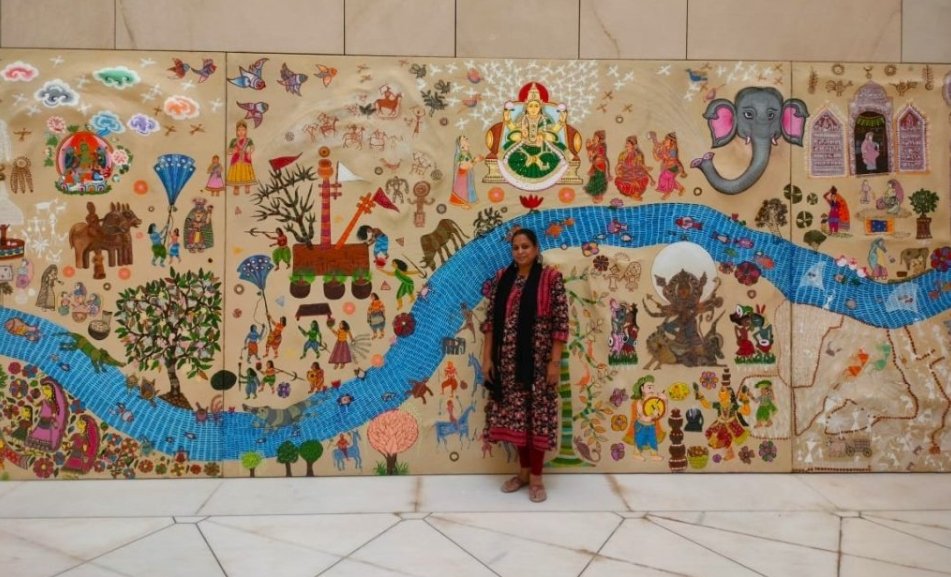
The 2023 project People’s Wall – Jan, Janani and Janmabhumi demonstrates the generational and cultural dimension of collective artistic expression on a national platform.
Created for the New Parliament House through the Lalit Kala Akademi, New Delhi, the project brought together women artists and artisans from different regions of India.
Majhi served as a Co-Sutradhar and creative contributor.
The project created a setting in which regional artistic knowledge could become part of a major contemporary cultural environment.
Different Generations, Different Expressions
Cultural continuity does not mean that every generation creates art in exactly the same way.
Younger artists may use photography, digital media, installations, public interventions, or mixed-media approaches.
Older traditions may rely on different materials and techniques.
The important point is that knowledge can travel between these forms.
Majhi’s multidisciplinary practice demonstrates this possibility.
Traditional knowledge can coexist with contemporary experimentation.
The Role of the Artist as Connector
Majhi’s roles as artist, curator, educator, and community practitioner allow her to operate across different cultural spaces.
She can work with artists and artisans, engage with communities, conduct workshops with children, contribute to public projects, and participate in contemporary exhibitions and residencies.
These activities create connections between people who may otherwise occupy separate cultural spaces.
The artist becomes a connector.
Curatorial Practice and Generational Dialogue
Curating can also create opportunities for generational exchange.
Exhibitions bring different artists, approaches, and ideas into the same space.
A younger artist may encounter traditional practices.
An established practitioner may encounter new experimental approaches.
Audiences can move between different generations of artistic expression.
Majhi’s curatorial engagement therefore complements her studio and community practice.
The Importance of Cultural Transmission
Knowledge survives when it is transmitted.
But transmission does not necessarily mean repetition.
A technique can be adapted.
A symbol can acquire a new interpretation.
A natural material can enter a contemporary composition.
A traditional story can inspire a new installation.
A community practice can influence public art.
Such transformations allow culture to remain alive.
Tradition Without Stagnation
One of the challenges of cultural preservation is avoiding the idea that tradition must remain frozen.
Living traditions change because communities change.
New materials become available.
New audiences emerge.
New social realities influence interpretation.
Contemporary artists can participate in this process by bringing traditional knowledge into new contexts.
Majhi’s practice provides an example of how this can happen through visual experimentation and community engagement.
The Future of Cultural Knowledge
The future of traditional and community-based knowledge depends partly on whether younger generations can encounter it meaningfully.
Art can provide one pathway.
When young people encounter traditional forms through workshops, public art, exhibitions, contemporary reinterpretations, and community projects, they can understand them as living sources of creativity rather than distant historical objects.
This makes artistic education particularly important.
Creativity as a Shared Inheritance
Cultural inheritance is not limited to objects.
It can include ways of observing, making, remembering, using materials, understanding landscapes, and telling stories.
Majhi’s artistic journey reflects this broader understanding of inheritance.
Her practice connects inherited knowledge with contemporary experience.
She demonstrates that creativity can be passed forward while still changing with each generation.
A Continuous Cycle of Learning
The relationship between generations can be understood as a cycle.
One generation passes on knowledge.
Another generation learns it, questions it, modifies it, and creates something new.
That new expression then becomes part of the cultural environment for the next generation.
Majhi’s practice participates in this cycle.
Her traditional art education influenced her own artistic development. Her community experiences expanded her understanding. Her workshops expose children to creative observation. Her public and collaborative projects bring diverse forms of knowledge into shared spaces.
Conclusion
Satyabhama Majhi’s artistic journey demonstrates how art can connect generations.
Her work brings traditional art education, indigenous knowledge, natural materials, community engagement, children’s creativity, public art, and contemporary artistic practice into a larger conversation about cultural continuity.
Her engagement with the Dongaria Kondh community shows the importance of learning from living cultural traditions. Her use of natural pigments demonstrates how material knowledge can continue in contemporary practice. Her long involvement with children’s art education creates opportunities for younger generations to develop their own visual voices.
Projects such as People’s Wall – Jan, Janani and Janmabhumi further demonstrate how diverse artistic knowledge can enter nationally significant cultural spaces.
The deeper value of this approach is that it does not treat generations as separate worlds.
The past can inform the present.
The present can reinterpret the past.
And the future can develop from both.
Through her work as an artist, educator, curator, and community practitioner, Satyabhama Majhi contributes to this continuing exchange.
Her practice reminds us that cultural knowledge becomes truly alive when it is not simply preserved, but observed, shared, questioned, transformed, and passed forward through new acts of creativity.