

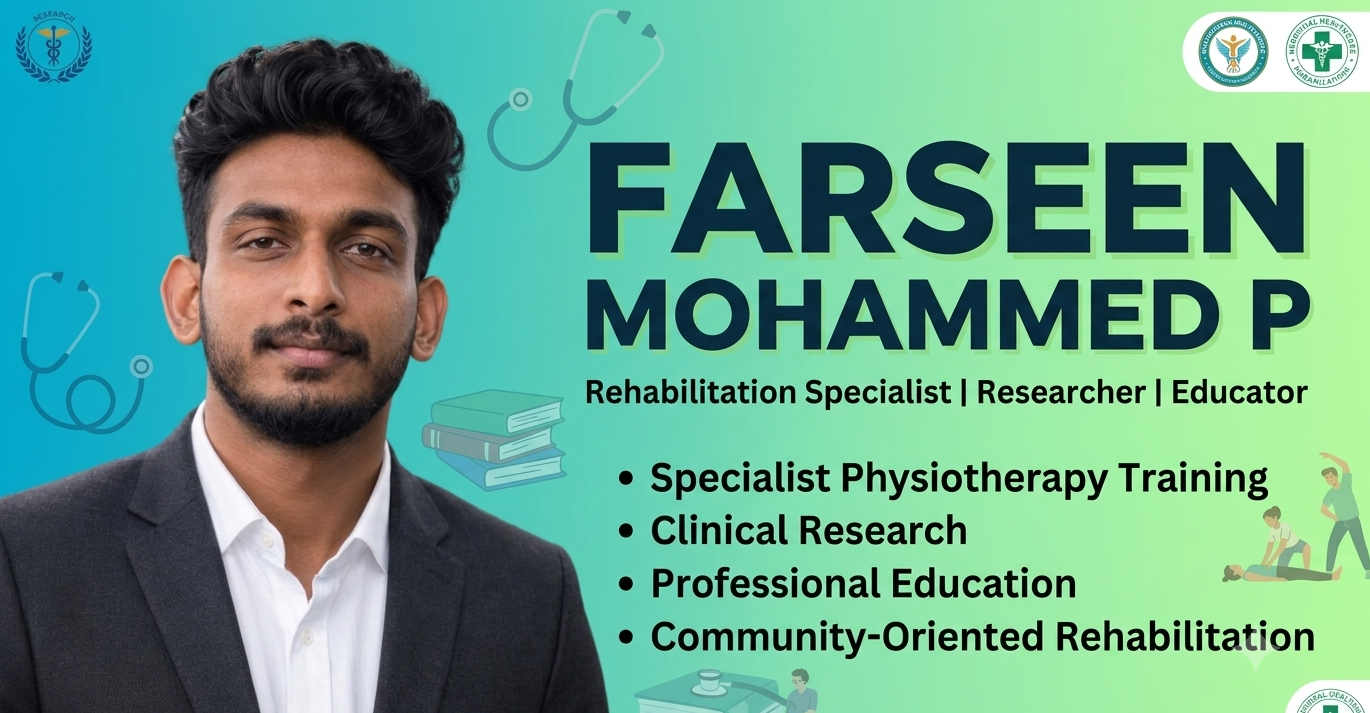
Mangaluru, Karnataka: Communicating scientific research effectively is an important skill for clinicians and researchers. Beyond conducting studies, researchers need to present research questions, methodologies and findings clearly to professional audiences. Farseen Mohammed P, a specialist physiotherapist in neurosciences and clinical researcher, has developed experience in scientific presentation through postgraduate research, professional conferences and academic activities.
His presentations have particularly focused on stroke rehabilitation, strengthening interventions and evidence synthesis.
From Researcher to Scientific Presenter
Farseen’s experience in scientific communication developed alongside his postgraduate education in neuroscience physiotherapy.
His Master of Physiotherapy programme at Yenepoya Physiotherapy College included clinical training and research activities.
His postgraduate dissertation examined:
“Effect of Eccentric Versus Concentric Strengthening on Functional Mobility in Subacute Stroke Patients: A Randomized Parallel-Group Comparative Study.”
The project later became the subject of an oral presentation at a professional physiotherapy conference.
Presentation at Mangalore PhysioCon 2026
Farseen presented his postgraduate research at Mangalore PhysioCon 2026, held on 10–11 April 2026 at the TMA Pai International Convention Centre in Mangaluru.
His presentation was titled:
“Effect of Eccentric Versus Concentric Strengthening on Functional Mobility in Subacute Stroke Patients.”
The presentation was delivered in the postgraduate category.
The opportunity allowed him to communicate his research to a professional physiotherapy audience.
Scientific Committee Participation
Farseen’s involvement in Mangalore PhysioCon extended beyond presenting his own research.
He served as an Organizing Member of the Scientific Committee.
This role provided exposure to the academic and organizational aspects of a professional scientific conference.
The event was organized by the South Canara Physiotherapy Teachers Association (R).
Participation in such activities can provide additional experience in academic collaboration and professional scientific communication.
Presentation at SYNERGOS 2026
Another important milestone in Farseen’s scientific presentation experience came at SYNERGOS 2026.
He presented:
“Effectiveness of Eccentric Strengthening Interventions in Stroke Rehabilitation: A Systematic Review.”
Unlike his postgraduate dissertation presentation, this work focused on evidence synthesis through a systematic-review approach.
The presentation reflected his developing ability to communicate research beyond an individual clinical intervention study.
First Prize for Oral Paper Presentation
Farseen received the First Prize in the Postgraduate Category for Oral Paper Presentation at SYNERGOS 2026.
The presentation took place on 9 May 2026 at Girideepam Convention Centre, Thiruvananthapuram.
The recognition became an important academic achievement during his postgraduate development.
It also demonstrated his involvement in presenting evidence-based physiotherapy research to a professional audience.
Communicating Different Types of Research
Farseen’s conference experience includes different forms of research communication.
At Mangalore PhysioCon, he presented postgraduate clinical research involving strengthening interventions and functional mobility.
At SYNERGOS, he presented a systematic review examining eccentric strengthening interventions after stroke.
The two presentations reflect different research methodologies and therefore required different approaches to scientific communication.
Evidence Synthesis and Scientific Communication
Farseen’s growing experience in systematic and scoping reviews has further strengthened his research communication profile.
His published Parkinson’s disease scoping review examined the timing of dopaminergic medication relative to physiotherapy delivery in adults with Parkinson’s disease.
He served as the second author and corresponding author of the publication.
Communicating evidence-synthesis research requires presenting information from multiple studies in an organized and understandable manner.
Developing Research Presentation Skills
Scientific presentations generally require researchers to communicate complex information within a limited period.
This can involve explaining the research problem, study design, methodology, outcomes and significance in a structured manner.
Farseen’s participation in oral presentations has provided opportunities to develop these skills within professional physiotherapy settings.
His recognition at SYNERGOS 2026 represents one milestone in this development.
Connection With Stroke Rehabilitation
Stroke rehabilitation has been central to Farseen’s presentation experience.
Both of his major 2026 research presentations focused on stroke-related rehabilitation.
His postgraduate dissertation investigated strengthening interventions in subacute stroke patients.
His systematic review examined eccentric strengthening interventions in stroke rehabilitation.
This consistency reflects his broader academic interest in stroke recovery and therapeutic exercise.
Clinical Background Supporting Research Communication
Farseen’s presentation activities are supported by his clinical training.
During postgraduate education at Yenepoya Medical College Hospital, he gained exposure to neurological rehabilitation involving stroke, Parkinson’s disease, traumatic brain injury, Guillain–Barré syndrome and spinal cord disorders.
This clinical background provides context for his interest in rehabilitation research.
His scientific presentations allow him to communicate selected clinical research questions within an academic environment.
Continuing Research Education
Farseen has continued developing his research methodology skills alongside his presentation experience.
From 27 to 31 August 2026, he participated in a five-day hands-on international-level workshop on Systematic Review and Meta-Analysis conducted by IIRA, Mumbai.
He has also completed training in Good Clinical Practice and health science research and publication.
These programmes complement his experience in preparing and communicating research.
Academic Communication Beyond Conferences
Farseen’s scientific communication activities have not been limited to conference presentations.
He has participated in academic and institutional activities, including the Institution’s Innovation Council awareness workshop on entrepreneurship and innovation as a career opportunity at Yenepoya Physiotherapy College.
He has also served as a resource person at a CME programme for nursing professionals.
His session, titled “Life After Discharge: Physiotherapy-Guided Secondary Prevention and Community Reintegration,” was delivered at St. Joseph’s Mission Hospital, Anchal, Kerala, on 5 September 2026.
These activities involve communicating professional knowledge to audiences beyond physiotherapy researchers.
Research Publication as Academic Communication
Scientific publication is another important form of research communication.
Farseen’s published Parkinson’s disease scoping review represents his experience in communicating research through an academic journal.
His role as corresponding author adds another dimension to this experience.
Together with his conference presentations, the publication contributes to his developing academic communication profile.
Building Confidence Through Professional Platforms
Professional conferences provide researchers with opportunities to discuss their work, receive academic feedback and interact with other professionals.
For an emerging clinical researcher, repeated presentation experience can contribute to confidence in scientific communication.
Farseen’s participation in Mangalore PhysioCon and SYNERGOS has provided two significant platforms during 2026.
His Scientific Committee involvement has further expanded his engagement with professional academic events.
Broader Research Interests
Although stroke rehabilitation has been prominent in his presentations, Farseen’s research interests extend to several areas.
His portfolio includes:
- Parkinson’s disease rehabilitation
- Therapeutic exercise
- Cardiac rehabilitation
- Metabolic health
- Evidence-based physiotherapy
- Clinical intervention research
- Systematic reviews
- Scoping reviews
- Evidence synthesis
These subjects provide potential areas for continued scientific communication as his research portfolio develops.
A Developing Academic Identity
Scientific presentation is becoming an important part of Farseen’s professional identity.
His journey has progressed from postgraduate clinical research to conference presentations, systematic-review work, published research and academic service.
Each activity contributes to his experience communicating physiotherapy research to different audiences.
Looking Ahead
Farseen Mohammed P’s scientific presentation experience represents an important part of his development as a clinical researcher.
His presentations at Mangalore PhysioCon 2026 and SYNERGOS 2026 have provided opportunities to communicate both original clinical research and evidence-synthesis work.
His published research, corresponding-author experience, Scientific Committee participation and CME teaching activity further broaden his communication experience.
As he continues developing his career in neuroscience physiotherapy and clinical research, scientific communication is likely to remain an important component of his professional journey.